A Pennsylvania judge's decision to uphold the state's tough new voter-identification law last month was based in part on a 19th century state court decision that at the time disenfranchised many Philadelphia workmen who the court didn't feel were virtuous enough to vote.
Voter rights advocates will ask the Pennsylvania Supreme Court on Thursday to overrule the Aug. 15 decision by Commonwealth Court Judge Robert Simpson. In his decision, Simpson heavily relied on an 1869 court case, Patterson v. Barlow, which legalized voting procedures uniquely for Philadelphia, with its large working class and immigrant populations.
"That process effectively disenfranchised the workmen who filled the city boarding houses at the end of the 19th century," University of Pittsburgh law professor Jessie Allen wrote in an opinion piece in the Pittsburgh Post-Gazette on Tuesday.
Simpson, in his ruling, quoted from the Patterson ruling, saying the discretion to establish voting requirements "belongs to the General Assembly, is a sound one, and cannot be reviewed by any other department of the government, except in a case of plain, palpable, and clear abuse of the power which actually infringes the rights of the electors."
What he didn't quote were the parts of the Patterson ruling warning that allowing Philadelphians to vote according to the same rules as the rest of the state would be “to place the vicious vagrant, the wandering Arabs, the Tartar hordes of our large cities, on a level with the virtuous and good man."
A reader of the election law blog run by Rick Hasen, who is a University of California Irvine voting expert and author, also noted the bigoted aspects of the Patterson ruling last month.
The court of the time wrote: “Where the population of a locality is constantly changing, and men are often unknown to their next-door neighbors; where a large number is floating upon the rivers and the sea, going and returning and incapable of identification; where low inns, restaurants and boarding-houses constantly afford the means of fraudulent additions to the lists of voters, what rule of sound reason or of constitutional law forbids the legislature from providing a means to distinguish the honest people of Philadelphia from the rogues and vagabonds who would usurp their places and rob them of their rights?"
The parties who initially sued to overturn the law, argue in their appeal of Simpson's decision that "Patterson is an anachronism, predating the modern framework of differing levels of scrutiny by more than half a century and based on outright prejudice. Patterson is no guide to a current construction of the constitutional rights of Pennsylvanians."
The Commonwealth of Pennsylvania also cites Patterson -- in its favor -- in its Sept. 7 brief to the Supreme Court.
The use of Patterson as legal precedent is particularly relevant, because opponents of the law allege that the current Pennsylvania legislature is similarly trying to use the law to prevent certain people from voting -- in this case, demographic groups that tend to vote Democratic.
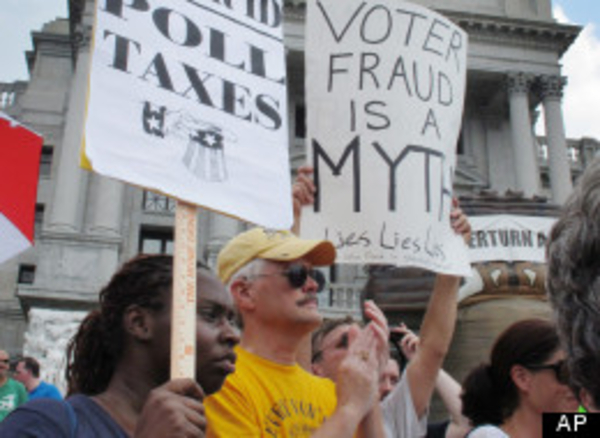
The state's voter ID bill came as Republican legislatures across the country pursued bills that would make it harder for people to vote, and register to vote. GOP supporters argue that the laws are necessary to reduce voter fraud, but voter fraud in general is extremely rare, and in-person voter fraud -- the only kind that would be affected by voter ID requirements -- is virtually nonexistent.
The opponents of the law cite ample evidence that the Pennsylvania law will in particular disenfranchise minorities.
Allen wrote in her piece: "Wrenched out of context, the legal language that the Commonwealth Court judge chose to quote from Patterson sounds like a fair basis for upholding the new voter ID law. But, in fact, the old Patterson case represents the Pennsylvania Supreme Court's shameful failure to protect elections from a law designed to make voting harder for some people than for others."
As Bob Warner reported for the Philadelphia Inquirer on Tuesday, Simpson "himself teed up" for the state's Supreme Court the issue of what level of judicial scrutiny should be applied to the legislature regarding voting procedure.
"[T]he appropriate level of scrutiny raises a substantial legal question," Simpson wrote in his opinion. "Indeed, if strict scrutiny is to be employed, I might reach a different determination on this prerequisite for a preliminary injunction."
 Posted By: DAVID JOHNSON
Thursday, September 13th 2012 at 9:44PM
You can also
click
here to view all posts by this author...